
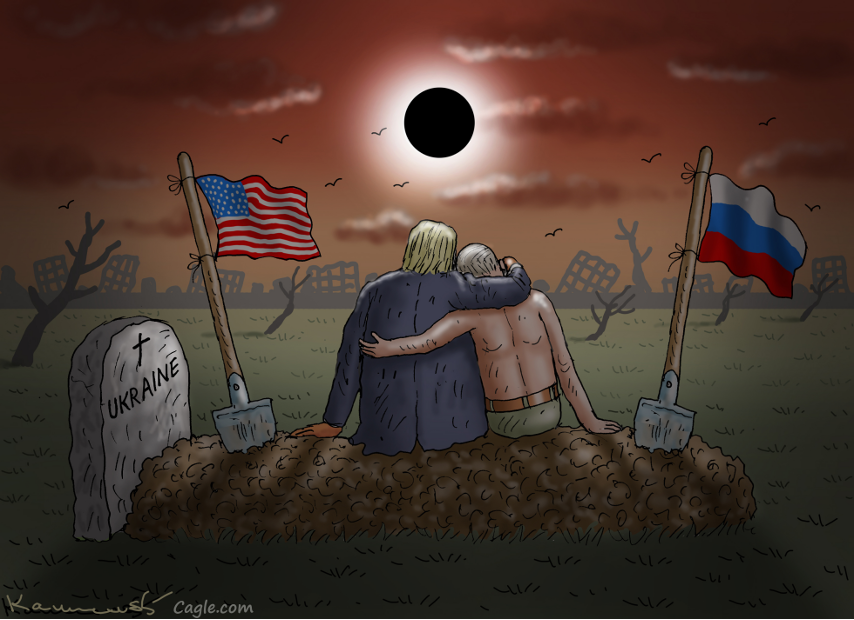
There has always been a disconnect between President Trump’s statements and actions regarding Russia’s genocidal war on Ukraine, his disconcerting “warm friendship” with war criminal Vladimir Putin, and – in my mind – disingenuous desire to “stop the killing.”
The Wall Street Journalhas now published the article below that brings so much into focus. In a fantasy view of the world, the actual vital national security interests of the United States are discounted to facilitate the pursuit of business opportunities with odious partners - everyone holding hands and making money will solve everything.
I say “fantasy” because, among other things, this entire approach ignores who Putin is and the history of Russia brutally. Yes, the few do well; others’ lives simply are of no consequence.
To emphasize this, below the Journal article, I include a piece from the Moscow TimesI shared with some of you earlier, “Handing the Donbas to Moscow Will Doom its People to Suffering,” making the point that the territories Russia occupies in Ukraine equal occupied people and people occupied by brutal Russian forces cannot – must not - be written off.
THE WALL STREET JOURNAL
Make Money Not War: Trump’s Real Plan for Peace in Ukraine
The Kremlin pitched the White House on peace through business. To Europe’s dismay, the president and his envoy are on board.
By Drew Hinshaw; Benoit Faucon; Rebecca Ballhaus; Thomas Grove; Joe Parkinson
Nov. 28, 2025 9:00 pm ET
Three powerful businessmen—two Americans and a Russian—hunched over a laptop in Miami Beach last month, ostensibly to draw up a plan to end Russia’s long and deadly war with Ukraine.
But the full scope of their project went much further, according to people familiar with the talks. They were privately charting a path to bring Russia’s $2 trillion economy in from the cold—with American businesses first in line to beat European competitors to the dividends.
At his waterfront estate, billionaire developer-turned-special envoy Steve Witkoff was hosting Kirill Dmitriev, head of Russia’s sovereign-wealth fund and Vladimir Putin’shandpicked negotiator, who had largely shaped the document they were revising on the screen. Jared Kushner, the president’s son-in-law, had arrived from his nearby home on an island known as the “Billionaire Bunker.”
Dmitriev was pushing a plan for U.S. companies to tap the roughly $300 billion of Russian central bank assets, frozen in Europe, for U.S.-Russian investment projects and a U.S.-led reconstruction of Ukraine. U.S. and Russian companies could join to exploit the vast mineral wealth in the Arctic. There were no limits to what two longtime adversaries could achieve, Dmitriev had argued for months: Their rival space industries, which raced one another during the Cold War, could even pursue a joint mission to Mars with Elon Musk’sSpaceX.
For the Kremlin, the Miami talks were the culmination of a strategy, hatched before Trump’s inauguration, to bypass the traditional U.S. national security apparatus and convince the administration to view Russia not as a military threat but as a land of bountiful opportunity, according to Western security officials. By dangling multibillion-dollar rare-earth and energy deals, Moscow could reshape the economic map of Europe—while driving a wedge between America and its traditional allies.
Dmitriev, a Goldman Sachs alumnus, had found receptive partners in Witkoff—Trump’s longtime golfing partner—and Kushner, whose investment fund, Affinity Partners, drew billion-dollar investments from the Arab monarchies whose conflict with Israel he had helped mediate.
The two businessmen shared President Trump’s long-held approach to geopolitics. If generations of diplomats viewed the post-Soviet challenges of Eastern Europe as a Gordian knot to be painstakingly unraveled, the president envisioned an easy fix: The borders matter less than the business. In the 1980s, he had offered to personally negotiate a swift end to the Cold War while building what he told Soviet diplomats would be a Trump Tower across the street from the Kremlin, with their Communist regime as a business partner.
“Russia has so many vast resources, vast expanses of land,” Witkoff told The Wall Street Journal, describing at length his hopes that Russia, Ukraine and America would all become business partners. “If we do all that, and everybody’s prospering and they’re all a part of it, and there’s upside for everybody, that’s going to naturally be a bulwark against future conflicts there. Because everybody’s thriving.”
When a version of the 28-point plan leaked earlier this month, it drew immediate protests. Leaders in Europe and Ukraine complained it reflected mostly Russian talking points and bulldozed through nearly all of Kyiv’s red lines. They weren’t assuaged even after administration officials assured them that the plan wasn’t set in stone, worried that Russia—after violently redrawing European borders—was being rewarded with commercial opportunities.

As Western leaders convened this week to digest the plan, Poland’s prime minister Donald Tusk offered a pithy summary: “We know this is not about peace. It’s about business.”
For many in the Trump White House, that blurring of business and geopolitics is a feature, not a bug. Key presidential advisers see an opportunity for American investors to snap up lucrative deals in a new postwar Russia and become the commercial guarantors of peace. In conversations with Witkoff and Kushner, Russia has been clear it would prefer U.S. businesses to step in, not rivals from European states whose leaders have “talked a lot of trash” about the peace efforts, one of these people said: “It’s Trump’s ‘Art of the Deal’ to say, ‘Look, I’m settling this thing and there’s huge economic benefits for doing that for America, right?’”
A question for history will be whether Putin entertained this approach in the interest of ending the war, or as a ploy to pacify the U.S. while prolonging a conflict he believes is his place in history to slowly, ineluctably win. [I personally would assume gullibility in anyone genuinely believing Putin wants anything other than complete victory and the destruction of Ukraine and the people of Ukraine. RAM]
One sign that he may be serious is that some of his most-trusted friends, sanctioned billionaires from his St. Petersburg hometown—Gennady Timchenko, Yuri Kovalchuk and the Rotenberg brothers, Boris and Arkady—have sent representatives to quietly meet American companies to explore rare-earth mining and energy deals, according to people familiar with the meetings and European security officials. That includes reviving the giant Nord Stream pipeline, sabotaged by Ukrainian tactical divers, and under European Union sanctions.
Earlier this year, Exxon Mobil met with Russia’s biggest state energy company, Rosneft, to discuss returning to the massive Sakhalin gas project if Moscow and Washington gave the green light.
Elsewhere, a cast of businessmen close to the Trump administration have been looking to position themselves as new economic links between the U.S. and Russia.
Gentry Beach, a college friend of Donald Trump Jr.and campaign donor to his father, has been in talks to acquire a stake in a Russian Arctic gas project if it is released from sanctions. Another Trump donor, Stephen P. Lynch, paid $600,000 this year to a lobbyist close to Trump Jr. who is helping him seek a Treasury Department license to buy the Nord Stream 2 pipeline from a Russian state-owned company.
There is no evidence that Witkoff, the White House or Kushner are briefed on these efforts or coordinating them. A person familiar with Witkoff’s thinking said the envoy is confident that any settlement with Russia would benefit America broadly, not just a handful of investors.
Witkoff, who hasn’t traveled to Ukraine this year, is set to visit Russia for the sixth time next week and will again meet Putin. He insisted he isn’t playing favorites. “Ukrainians have fought heroically for their independence,” said Witkoff, who has tried to inspire Ukrainian officials with the idea of soldiers disarming to earn Silicon Valley-scale salaries operating American built AI data centers. “It is now time to consolidate what they have achieved through diplomacy,” he said.
“The Trump administration has gathered input from both the Ukrainians and Russians to formulate a peace deal that can stop the killing and bring this war to a close,” said White House spokesperson Anna Kelly. “As the President said, his national security team has made great progress over the past week, and the agreement will continue to be fine-tuned following conversations with officials from both sides.”
An administration official said that Kushner and Witkoff also met with Ukraine’s national security adviser, Rustem Umerov, in Miami and spoke with Ukrainian President Volodymyr Zelensky. The official said that while Trump has “done a lot of new, important things regarding economic incentives,” he and his team have also been focused on “geopolitical and military realities.”
As Witkoff pursued talks with Dmitriev over nine months, some agencies inside the Trump administration had a limited view of his dealings with Moscow.
In the lead-up to an August summit in Alaska between Trump and Putin, Witkoff and Dmitriev discussed a prisoner exchange that would have been the largest bilateral swap in their countries’ history. The Central Intelligence Agency, which traditionally manages prisoner trades with Russia, wasn’t fully briefed on that proposed exchange. Nor was the State Department’s office for unjustly imprisoned Americans. The CIA didn’t return requests for comment. The State Department referred questions to the White House.
Career officials in the office overseeing sanctions at the Treasury Department have at times learned details of Witkoff’s meetings with Moscow from their British counterparts.
In the days after Alaska, a European intelligence agency distributed a hard-copy report in a manila envelope to some of the continent’s most senior national security officials, who were shocked by the contents: Inside were details of the commercial and economic plans the Trump administration had been pursuing with Russia, including jointly mining rare earths in the Arctic.
Witkoff has worked closely with Vice President JD Vance and Secretary of State Marco Rubio. But Trump’s special envoy for Ukraine, former Lt. Gen. Keith Kellogg, has been all but frozen out of serious talks, and last week said he is leaving the government.
To understand the story behind the administration’s Russia negotiations, The Wall Street Journal spoke to dozens of officials, diplomats, and former and current intelligence officers from the U.S., Russia and Europe, and American lobbyists and investors close to the administration.
The picture that emerges is a remarkable story of business leaders working outside the traditional lines of diplomacy to cement a peace agreement with business deals. [If completed, it would necessarily require a new definition of “peace”. RAM]
A visitor from Moscow
Witkoff was just weeks into his new job as President Trump’s Russia and Ukraine negotiator when his office asked the Treasury Department for help allowing a sanctioned Russian businessman to visit Washington.
Kirill Dmitriev, an investment banker with degrees from Harvard and Stanford, spoke Witkoff’s preferred language: business. He had invited Witkoff to Moscow in February and escorted him into a three-hour meeting with Putin to discuss the Ukraine war. But Dmitriev was persona non grata in the U.S, blocked by the Treasury in 2022 for his role leading his country’s Sovereign Wealth Fund, which it called a “slush fund for Vladimir Putin.”
Trump had told Witkoff he wanted the war to end and the administration was willing to take the risk of welcoming Putin’s emissary to Washington. Treasury Secretary Scott Bessent had questions about the unique request, but ultimately signed off.
Dmitriev arrived at the White House on April 2 and presented a list of multibillion-dollar business projects the two governments could pursue together. At one point, Secretary of State Marco Rubio told Dmitriev that Putin needed to demonstrate he was serious about peace.
But Dmitriev felt his businesslike rapport was breaking through. “We can transition investment trust into a political role,” he said in an unpublished interview that month.
In April, Dmitriev welcomed Witkoff to the St. Petersburg presidential library for another three-hour meeting with Putin. Witkoff took his own notes, relying on a Kremlin translator, [Emphasis on genuine stupidity added. RAM] then briefed the White House from the U.S. Embassy. That same month, European national security advisers planned to meet Witkoff in London to integrate him into their peace process. But he was busy with his other portfolio—negotiating a cease-fire in Gaza—and couldn’t make it. Afterward, one European official asked Witkoff to start speaking with allies over the secure fixed line Europe’s heads of state use to conduct sensitive diplomatic conversations. Witkoff demurred, as he traveled too much to use the cumbersome system.
Dmitriev and Witkoff meanwhile were chatting regularly by phone about increasingly ambitious proposals. The U.S. and Russia were discussing major agreements on oil-and-gas exploration and Arctic transportation, Dmitriev told the Journal. “We believe that the U.S. and Russia can cooperate basically on everything in the Arctic,” he said. “If a solution is found in Ukraine, U.S. economic cooperation can be a foundation for our relationship going forward.”
Into position
American and Russian business leaders were quietly anticipating that Witkoff and Dmitriev would deliver, positioning their companies to profit from peace.
In secret talks, Exxon Mobil Senior Vice President Neil Chapman met Rosneft boss Igor Sechin, Putin’s former private secretary, in the Qatari capital Doha, to discuss Exxon’s return to the massive Sakhalin project, an investment stranded after Russia’s 2022 invasion of Ukraine.
Exxon, billionaire investor Todd Boehly and others have explored buying assets owned by Lukoil, Russia’s second-largest oil producer. The U.S. sanctioned Lukoil in October to increase pressure on Moscow, prompting the company to put its overseas assets up for sale. Elliott Investment Management eyed buying a stake in a pipeline that carries Russian natural gas into Europe.
More recently, Kremlin-linked businessmen Timchenko, Kovalchuk and the Rotenbergs have been offering U.S. counterparts gas concessions in the Sea of Okhotsk, as well as potentially four other locations, according to a European security official and a person familiar with the talks. Russia has also mentioned rare-earth mining opportunities near the massive nickel mines of Norilsk and in as many as six other Siberian locations that are still unexploited, these people said.
Beach, Trump Jr.’s college friend, was in talks to acquire 9.9% of an Arctic LNG project with Novatek, Russia’s second-largest natural gas producer—which is partly owned by Timchenko—if the U.S. and U.K. remove sanctions on it, according to drafts of contracts reviewed by the Journal.
In a statement, Beach said that partnering with Novatek would “strongly benefit any company committed to advancing American energy leadership,” and that his company, America First Global, “actively seeks investment opportunities that strengthen American interests around the world.” He said he “has never worked with Steve Witkoff” but is “extremely grateful” for the efforts Witkoff and others are making to end the war in Ukraine. Trump Jr. has told people he isn’t doing business with Beach.
Meanwhile, Lynch, the Miami-based investor, had been asking the U.S. government to allow him to bid on the sabotaged Nord Stream Pipeline 2 if it came up for auction in a Swiss bankruptcy proceeding. Lynch, who in 2022 was given a license by Treasury to complete the acquisition of the Swiss subsidiary of Russia’s Sberbank, had been seeking a license for the pipeline since the Biden administration, but in April dialed up his lobbying efforts by hiring Ches McDowell, a friend of Trump Jr. He would pay McDowell’s firm $600,000 over the next six months. Lynch’s representatives reached out to Witkoff for a meeting.
In late July, Dmitry Bakanov, the head of Russia’s Roscosmos space agency, visited NASA’s Lyndon B. Johnson Space Center in Houston—the first such visit since 2018—as well as the spacecraft manufacturing facilities of Boeing and SpaceX.
The road to Miami
The chess pieces were moving into position. But all of it hung, to some degree, on whether Witkoff could unlock the conflict his boss had pledged during his campaign to resolve in a single day.
On Aug. 6, Witkoff flew to Moscow, at Putin’s invitation, for a meeting prepared only a few days in advance. Dmitriev walked him through Zaryadye Park overlooking the Moskva River, then escorted him to the Kremlin for another three-hour session with Russia’s leader. Putin mentioned wanting to meet with Trump personally. He gave Witkoff a medal, the Order of Lenin, to pass to a CIA deputy director whose mentally unwell son was killed fighting for Russia in Ukraine.
The next day, Witkoff dialed into a videoconference with officials and heads of state from top European allies, and explained the outlines of what he understood to be Putin’s offer. If Ukraine would surrender the remaining roughly 20% of Donetsk province that Russia had failed to conquer, Moscow would forfeit its claim to Zaporizhzhia and Kherson provinces. The European officials were confused. Did Putin mean he would withdraw his troops from Zaporizhzhia and Kherson, as Witkoff was suggesting? Or, more likely, was Putin merely promising to not conquer the thousands of square miles of those two provinces that, after years of bloody fighting, remained in Ukrainian hands? Either way, Ukraine was skeptical about the value of a promise from Putin.
On Aug. 9, Witkoff retreated to the Spanish island of Ibiza. European leaders were still seeking clarity from him, the White House, and the State Department, on what exactly Putin had offered.
Witkoff wanted to strike while the iron was hot and hold a summit without delay. Dmitriev was optimistic Witkoff had taken Russia’s sensitivities on board: “We believe Steve Witkoff and the Trump team are doing a great job to understand the Russian position to end the conflict,” he told the Journal, a few days before.
The Aug. 15 summit fell apart almost as soon as it began. Witkoff, Rubio, and Trump arrived on Air Force One, meeting Putin, his longtime adviser Yuri Ushakov, and Foreign Minister Sergei Lavrov. Putin launched into a 1,000-year history lecture on the unity of the Russian and Ukrainian people. The two sides canceled a lunch and an afternoon session where they were meant to check through their other issues, like the exchange of prisoners. Witkoff left uncertain where things stood, but hopeful talks would accelerate soon. “Everyone was working hard, but it was positive,” he said.
In October, President Zelensky flew to Washington, hoping to secure long-range, U.S.-made Tomahawk cruise missiles. His military wanted to cripple Russian refineries, pushing Moscow to negotiate on better terms.
By the time Zelensky arrived, Trump had spoken to Putin a day earlier and decided not to offer the Tomahawks. [We have all seen the transcript of Witkoff’s briefing Russia on how to deal with Trump in advance of the Zelenskyy trip to Washington. RAM] Instead, Witkoff encouraged Ukrainian officials to try another tack: What good was a handful of missiles going to accomplish? Instead, he encouraged Ukraine to ask Trump for a 10-year tariff exemption. It would supercharge their economy, he said.
“I’m in the deal settlement business. That’s why I’m here,” he told the Journal. “We keep on knocking at the door and coming up with ideas.”
The Moscow Times
Handing the Donbas to Moscow Will Doom its People to Suffering
Remember how everyone recently laughed at the UN for publishing a tearful report saying that no one reads its reports? Well, I can tell you about a fresh report that will sadly be read by even fewer people than any UN document.
Because each of its 224 pages is filled with blood and torture. In every third paragraph, someone is being beaten or electrocuted. And when there’s no beating or torture, there’s a tedious explanation of Russian missile guidance systems and why international law prohibits using such systems at night for strikes on cities — even if the missiles are supposedly high-precision and aimed strictly at military targets.
This report from the Memorial Human Rights Center, titled “Ukraine: War Crimes of the Russian Aggressors,” presents the results of our trip to Ukraine in January 2025.
To give our report even a chance of getting as many views as the UN’s work, I won’t spoil where exactly we were, why we went or what we saw. But I will explain why it’s still worth reading, even if we were slow to publish.
At a time when peace plans, amnesties for war criminals and lifting various sanctions are being discussed, it is crucial to know and remember what Russia is doing in the occupied territories.
For example, Russian soldiers gouged a man’s eye out because they found a blue-and-yellow discount card from the Ukraina supermarket in his wallet. The card, they claimed, indicated sympathy for Nazism.
Other Russians mockingly staged a mass execution of several dozen people the day before withdrawing from Kherson.
Others went a step further by actually executing three brothers simply because the eldest had once served in the Anti-Terrorist Operation (the Ukrainian mission to defend its territorial integrity in 2014-2018). The middle brother miraculously survived after a bullet hit him in the jaw. He crawled out of what was literally a mass grave, made his way back to the village by back roads and told them everything.
Russian soldiers also stole cars and engaged in other forms of looting and torture as brutal as their imagination can concoct. Always with taunts of “fascist” and “Banderite scum,” and the words, “And what made you think you can live better than us?” They demanded that victims point to hidden weapons caches — even if none existed — or confessed to collaborating with the ultranationalist Right Sector and other “Yarosh business cards,” even if the victim had no idea what they were talking about.
This is the terror Russia establishes in the occupied territories.
It is also crucial that all prisoners — military and civilian alike — be returned to Ukraine. It doesn’t matter who they are exchanged for. It is just imperative that not a single Ukrainian hostage is left in Russia.
Moscow does not think that the Geneva Conventions apply to Ukrainian captives. After all, this is not a war, but a “special military operation,” meaning prisoners are not prisoners but terrorists. Military drills? That’s training for terrorist activity. Captured in Russia’s Kursk region? Then they “illegally crossed the border.”
Let me digress from prisoners and quickly explain how fighters from the Azov and Aidar battalions are sentenced for involvement in a “terrorist community,” because such acrobatics of legal thought deserve public attention.
In 2015, Liubov Selina, a 30-year-old woman from the Luhansk region, worked for five and a half months as a secretary in the Aidar battalion. To be precise, she actually worked for the former Aidar battalion — because it was officially disbanded in 2015 and reorganized into the 24th Separate Assault Battalion of the Ukrainian Ground Forces.
But, eight years later, the Southern District Military Court sentenced Selina to five years in prison — almost one year for each month — under Article 205.4, Part 2 of the Russian Criminal Code (“participation in a terrorist community”). The sentence entered into force on Nov. 22, 2023. It has still not been published, but based on this ruling, Aidar was added to Russia’s list of terrorist organizations in December 2023.
I’m sure you understand what this means. They found a random person whose link to Aidar could be documented, somehow concluded during the “trial” that Aidar was a terrorist organization, convicted this poor woman and then used the sentence itself as grounds for designating Aidar a terrorist organization. That Aidar doesn’t formally exist didn’t stop Russia. Nor did the non-existence of the “international LGBT movement.”
It gets even crazier. Fifteen so-called Aidar fighters were recently sentenced to terms from 15 to 21 years for participating in a terrorist organization. They were captured in spring 2022 — a year and a half before the nonexistent Aidar battalion was even added to the terrorist list.
At least these men are known to be alive; they can talk to lawyers and receive parcels, etc. Hundreds of other Ukrainian prisoners are held “incommunicado” and cannot be reached. Russia’s Defense Ministry says they were “detained for resisting the special military operation,” and that’s it: they can do anything to them.
Imagine being forced to stand motionless from six in the morning until eight in the evening without shifting your weight or leaning on anything. Move, and they beat you. This goes on for months while you develop varicose veins, ulcers or gangrene. This is how they torture people at the notorious Penal Colony No. 10 in Mordovia. In addition, prisoners have dogs set on them, suffer beatings and are forced to memorize “Katyusha” and the Russian national anthem.
These tactics appear to be a grim inheritence passed down from Russia’s past. They aren’t the only thing to have been inherited: Penal Colony No. 10 was not chosen by accident. In the 1960s, it was one of the few places where political prisoners and foreigners were held, along with members of armed underground groups from the North Caucasus. The settlement where the camp is located is symbolically called Udarny (“Shock/Strike”).
Modern filtration points did not appear out of thin air — they were copied from those used during the Chechen wars, which Memorial has written about many times.
We can now afford to say we warned you.
Although, as the dissident Alexander Esenin-Volpin liked to say, we did not “put logic into this system.” Therefore, it is pointless to look for it: a pattern of brutality is unmistakably visible from Chechnya through Georgia and Syria to Ukraine.
ROBERT MCCONNELL
Co-Founder, U.S.-Ukraine Foundation
Director of External Affairs, Friends of Ukraine Network
The introduction and parenthetical comments are Mr. McConnell’s and do not necessarily reflect the views of the U.S.-Ukraine Foundation or the Friends of Ukraine Network (FOUN).