
THE ATLANTIC
Siding With Putin Is a Huge Mistake
The United States should stand unequivocally with Ukraine against Russia.
By David J. Kramer, John Herbst, and William Taylor | October 18, 2026, 6:26 PM ET
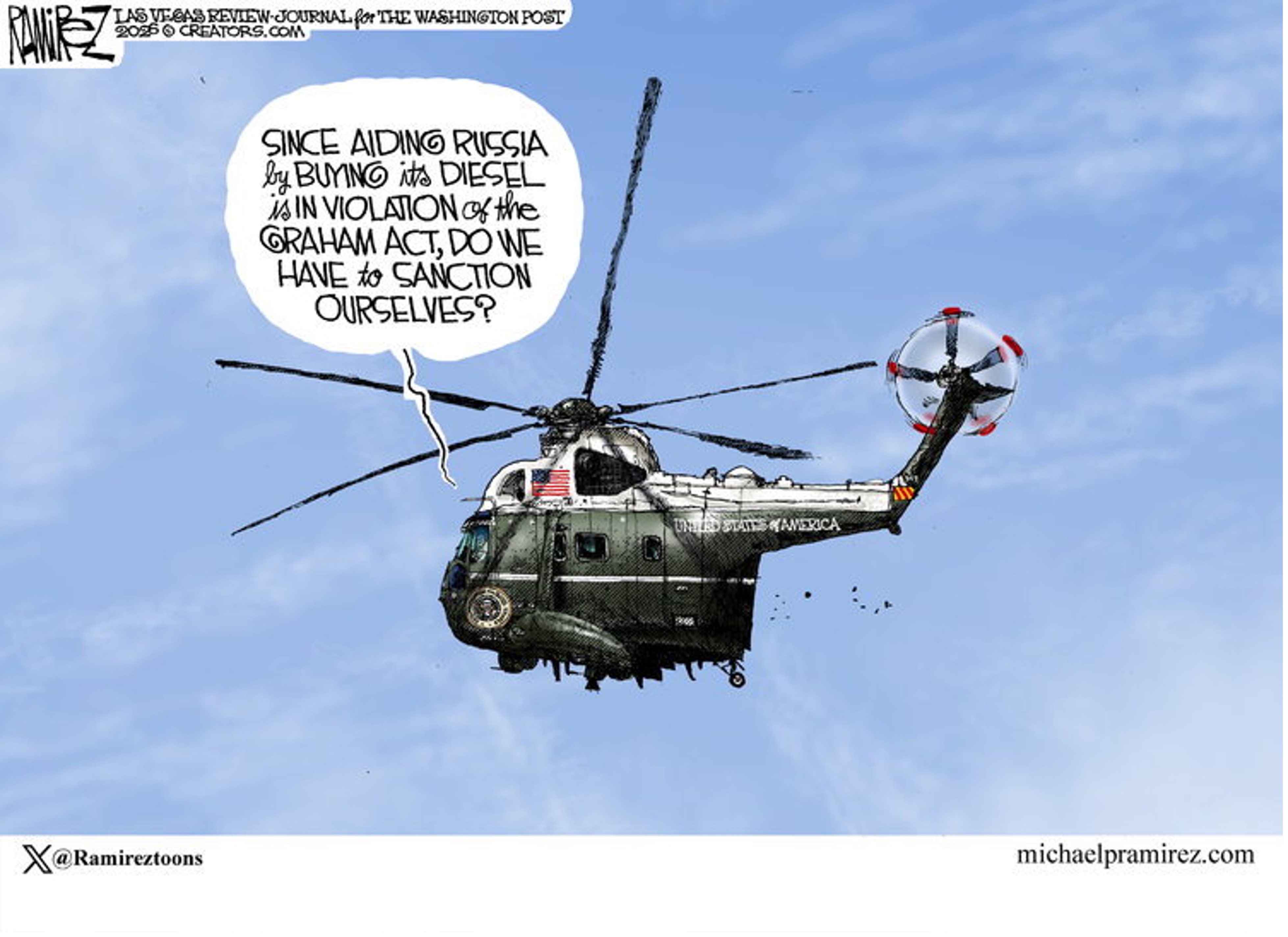
President Trump’s inexplicable decision to waive some sanctions on Russia, announced late Friday, essentially gives a pass to the forces of evil in the Kremlin. [I would have used “inexcusable” instead of “inexplicable” as I believe the slavish thirst for business deals is at least much of the explanation. RAM] The move effectively nullifies legislation that was named after the late Republican Senator Lindsey Graham, passed by huge bipartisan majorities in both the House and Senate, and signed by the president. This decision is the latest in a long series that this administration has taken to appease or accommodate the Russians in misguided attempts to get them to negotiate. Russian President Vladimir Putin pockets these naive offerings and still refuses to talk.
Surveys show that most Americans stand with Ukraine as it defends itself against Russia, view Putin as a dangerous threat who shouldn’t be trusted, and want to see the United States offer more assistance to Ukraine.
Few wars in recent history have been so black-and-white: Russia is the guilty party that invaded Ukraine for no good reason. Ukraine is, for its part, defending its freedom, sovereignty, and territorial integrity.
And yet there is much misinformation and disinformation circulating that blurs the picture. To address the problem of phony narratives, it is useful to contrast Russia and Putin with Ukraine and its president, Volodymyr Zelensky.
Putin came to power in August 1999, when his predecessor, Boris Yeltsin, designated him prime minister and his preferred successor; Yeltsin resigned from office at the end of that year and named Putin acting president, three months before the next presidential election. Putin had used his time as prime minister to deploy brutal force against the Chechens in 1999. Zelensky became the leader of Ukraine in 2019, when he won by a landslide in a free and fair election certified by domestic and international observers. Putin hasn’t won a legitimate election throughout his two-plus decades in power.
Putin is a murderous dictator who kills his own citizens as well as those of his neighbors. He treats his troops as cannon fodder. Zelensky is a democratically elected leader whose term has been extended because Ukraine cannot credibly conduct elections under martial law, which was declared after Russia invaded on a full scale in 2022.
Under Putin, Russian forces deliberately target civilian areas, including hospitals, apartment buildings, and schools. They also seek to destroy energy facilities and water supplies to freeze out Ukrainians and force them into submission. Zelensky and Ukrainian forces focus on Russian energy facilities that provide Putin with funding for his war campaign, but generally seek to minimize civilian casualties.
Putin first started the war against Ukraine in 2014, when he illegally annexed Crimea and then moved into Ukraine’s Donbas region. Zelensky wasn’t even in politics that year, so he can’t be blamed for starting the war.
Putin refuses to end the war, enter serious negotiations, or even entertain a cease-fire. Zelensky and Ukraine have shown tremendous willingness to negotiate, freeze the fighting at its current stage, and sort out the status of Russian-occupied land through diplomacy, without conferring recognition of Russian control.
Putin has ignored Trump’s repeated efforts to end the war, including the recent energy-cease-fire announcement, by continuing to strike Ukrainian energy targets. Zelensky had suspended retaliatory strikes against Russian refineries for three days but lifted that pause after Russia kept bombing Ukraine.
Putin sought to topple the Zelensky government through his full-scale invasion, in 2022, to take over massive amounts of Ukrainian territory and to subjugate the country under Russian rule. Zelensky and the people of Ukraine simply have sought to live in peace and exercise their right to determine their independent future.
Putin wishes to challenge and undermine democratic nations and the institutions that bring them together, such as NATO and the European Union. Ukraine seeks to join these institutions and assume its rightful place as a full member of the Euro-Atlantic community.
Putin supports Iran against the United States, providing both intelligence aimed to target and kill Americans as well as weapons systems to help that cause. Zelensky and Ukraine offered the United States and its allies in the Middle East anti-drone capabilities and insights on how to fight the Iranian Shahed drones, which have been used against Ukraine.
Putin relies on North Koreans and others who have been trafficked into Russia’s side of the war. Casualties are merely a statistic for him and for North Korea’s leader, Kim Jong Un. Zelensky has never asked the West to send its troops to fight on Ukraine’s side, but he does seek Western assistance to defend against the much larger Russian military.
Putin depends on China’s purchases of Russian energy and provision of dual-use technology to back his war. Ukraine looks to the West for its support.
Putin and Russia are key parts of CRINK, the grouping of the authoritarian regimes in China, Russia, Iran, and North Korea that seek to weaken and threaten the West. Ukraine is the bulwark against a major part of this dangerous alignment.
Putin and Russian forces have launched provocations against Europe and the United States, almost daring war with the West. These have included major violations of NATO airspace; drone attacks and interference with European airports and flights; assassinations and attempted killings on Western soil; cyberattacks; and election interference. Ukraine stands between Russia and Europe, fighting for its freedom as well as the safety and security of the continent.
Putin oversees one of the most corrupt regimes in the world. He has obliterated rule of law and sanctity of contracts, making Russia a highly inhospitable place to do business, including in the energy sector. Ukraine, while experiencing its own problem of corruption, actively seeks to confront that problem while encouraging and desperately needing Western investment. Russia ranks 157th out of 182 nations in Transparency International’s corruption index, while Ukraine ranks 104th. Putin has destroyed Russian civil society; Ukrainian civil society is vibrant and calls out corruption on a regular basis.
What does all of this mean for the United States and Europe? For starters, they should stand unequivocally with Ukraine against Russia. History will reflect poorly on the West if it concludes that our policy and position were wishy-washy at best in a war so clearly black-and-white.
They should provide the military assistance that Ukraine needs to defend itself, save lives from Russian bombardment, regain territory that Russia illegally occupies, and win the war. The war has been an unmitigated disaster for Russia; more than 1.5 million have been killed or wounded, and the conflict has caused severe economic strain. At some point, Russia might reach a breaking point; the West should help accelerate that process, because that may be the only way to get Putin to end the war he started.
Europe should support Ukraine financially to help offset the costs of Ukraine’s forced increased military spending and reconstruction. To do this, Europe should finally move from freezing to seizing the roughly $300 billion in Russian assets that are in Western financial institutions, mostly in Belgium’s Euroclear. These funds, which Russia should never recover after what it has done to Ukraine, would provide a major financial assist to Ukraine and allay the potential burden on the West.
Pressure to end the war should be applied and increased on Putin and Russia, the ones who started it—not Ukraine. This means a serious tightening of sanctions implementation, including stronger enforcement against Russia’s shadow fleet that generates energy-export income, and no business deals with Russia that ease the sanctions pressure and provide financing for its war effort. It means ending loopholes that allow Western-made parts essential for Russian weapons to slip through the sanctions.
The United States should also raise the costs on countries—especially China and India—that import Russian energy. And the West should not sign energy or any other deals with Putin and Russia, as the Trump administration announced on October 9 regarding diesel. Such efforts are read in Moscow as weakness and reinforce Putin’s thinking that he is winning and can outlast the West’s support for Ukraine.
The West should stop inviting Putin to various meetings, such as the G20 gathering hosted this year by the United States. He has been indicted by the International Criminal Court for war crimes against Ukraine (specifically the abduction of Ukrainian children, though he is guilty of much more). He is responsible for the worst security crisis on the European continent since World War II. He needs to be isolated and treated as the pariah and threat that he is, not welcomed with red-carpet treatment.
ROBERT MCCONNELL
Co-Founder, U.S.-Ukraine Foundation
Director of External Affairs, Friends of Ukraine Network