
The Wall Street Journal has published an excellent piece by our friend George Weigel addressing the anti-Christian, anti-religious leadership of today’s Russian Orthodox Church.
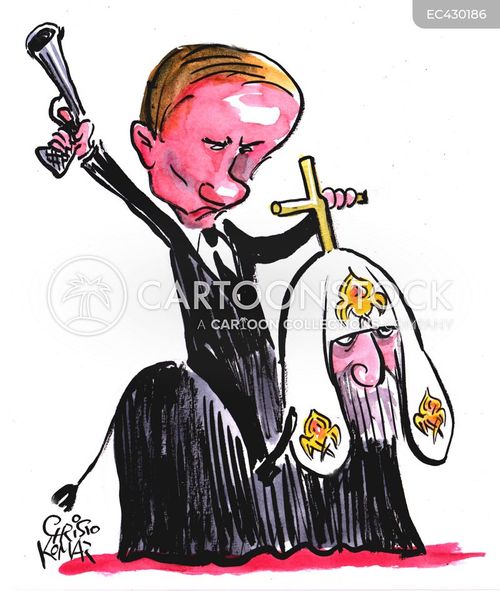
Patriarch Kirill of Moscow is an all-in advocate supporting Putin’s war to exterminate Ukraine.
Please read the Weigel piece below, nothing “preached” by the Russian Orthodox leadership has any moral or religious value, it is nothing more than another propaganda voice for the Kremlin.
Putin’s War and Kirill’s Blasphemy
The head of Russia’s Orthodox Church betrays his faith to support the state.
George Weigel | Aug. 6, 2026 6:56 pm ET
As Russian missiles and drones continue their assault on Ukrainian civilians, the head of the Russian Orthodox Church, Patriarch Kirill of Moscow, has just published “War: Beyond the Visible Causes and Consequences,” doubling down on his campaign to justify in religious terms Russia’s war of extermination against Ukraine.
Issued by the official publishing house of the Moscow patriarchate, the book casts Vladimir Putin’s war as a salvific action: a duty to God and a Russian service to a corrupt world. Patriarch Kirill lurched into heresy when he promised Russian soldiers immediate entrance into heaven, their sins forgiven, if they die in Mr. Putin’s “holy war.” Now Patriarch Kirill asserts the “great responsibility” of the Russian people is to win the war because “our earthly vocation is to be warriors of the Lord, to resist evil.” God has determined the war’s outcome, he writes, “and victory belongs to those who stand on the side of the light.”
In the first decades of Soviet communism, Russian Orthodoxy gave a great witness of martyrdom, even as its exiled thinkers enriched Christian theology and fostered ecumenical dialogue. But since 1943—when Stalin, trying to strengthen patriotic resistance to the Nazi war machine, relegitimized the Orthodox Church—the church’s leadership has been under the Kremlin’s thumb. Its leaders, including the current patriarch, have had strong connections to Moscow’s security services. Perhaps as a result, all of them have had a special loathing for Ukrainian national consciousness. The Moscow patriarchate worked hand in glove with Soviet spymasters to orchestrate a spurious Ukrainian church council in 1946, which legally abolished the Ukrainian Greek Catholic Church, a custodian of Ukrainian culture and identity.
Since its re-emergence from underground at the end of the Gorbachev period, the UGCC has become a spiritual, cultural and intellectual force in Ukraine. Its moral authority has grown since Mr. Putin’s war began, thanks to the self-sacrificial courage of its clergy and lay leaders. Russian secret-police operatives were surveilling the UGCC’s leader, Major Archbishop Sviatoslav Shevchuk, during the 2025 papal conclave in Rome. Archbishop Shevchuk, who was on a list to be liquidated if Russian forces had captured Kyiv in February 2022, has promoted Ukraine’s cause since then, providing his people spiritual nourishment and spending countless nights in a bomb shelter. Patriarch Kirill’s blasphemous justification of Mr. Putin’s war stands in contrast to the Ukrainian churchman’s pastoral dedication and theological integrity.
The “first among equals” in world Orthodoxy is Ecumenical Patriarch Bartholomew of Constantinople, who has recognized the independent legitimacy of Ukrainian Orthodox bodies formerly subservient to Moscow. He has criticized Russian aggression and specifically condemned Patriarch Kirill’s efforts to give a veneer of religious sanction to the war. Which is why, even before the Russian invasion, Patriarch Kirill broke relations with Constantinople. The two churches are now formally estranged. This deep ecumenical fracture won’t be healed for some time after the war.
Patriarch Kirill’s new book raises another ecumenical question, whether ecumenical dialogue between Roman Catholicism and Russian Orthodoxy is effectively over. For decades, the Roman professionals in charge of Catholicism’s post-Vatican II efforts to recompose unity with Eastern Orthodoxy have been guided by a strategic idea: the road to Constantinople runs through Moscow. The theory is that once a degree of ecumenical rapprochement was achieved with Moscow, other advances with the Christian East would follow.
Whatever sense that strategy may have made 60 years ago, it makes no sense now. Russian Orthodoxy’s leaders are instruments of Russian state power, not people with whom serious theological conversation is possible. The patriarchate of Moscow does more than underwrite the Kremlin’s brutal aggression against Ukraine. As former patriarchate official Sergei Chapnin documents in his book “Religious Communities Under Pressure,” the Russian Orthodox Church persecutes and disowns any of its clergy and laity who oppose the war on Ukraine. Mr. Chapnin warned a decade ago that Patriarch Kirill was transforming Russian Orthodoxy into a political ideology and later predicted that he would valorize a future Russian war against Ukraine in religious language. Now he demonstrates that the Moscow patriarchate’s campaign of repression, which included the death of a nondenominational antiwar protester in a penal colony, targets any religious believer who challenges Kremlin policy and practice.
Ecumenical dialogue isn’t possible with men who have betrayed the Gospel, blessed an autocrat’s aggression, trampled on religious freedom and mortgaged the liberty of their own church to state power.
A thorough rethinking of Vatican ecumenical strategy toward the Christian East is essential. That old idea of a “road through Moscow” hasn’t led to Constantinople. It has led only to the betrayal of Christian truth and the shattering of ecumenical hope.
Mr. Weigel is a distinguished fellow at the Ethics and Public Policy Center.
Appeared in the August 7, 2026, print edition as ‘Putin’s War and Kirill’s Blasphemy’.
ROBERT MCCONNELL
Co-Founder, U.S.-Ukraine Foundation
Director of External Affairs, Friends of Ukraine Network
The introduction is Mr. McConnell’s and does not necessarily reflect the views of the U.S.-Ukraine Foundation or the Friends of Ukraine Network (FOUN).