
Dear Colleagues,
Provided is our follow-up policy brief, “Lessons from Oleshky: The Very Good, the Bad and the Very Ugly,” prepared by experts of the FOUN International Human Rights Task Force, an initiative of the U.S.-Ukraine Foundation.
This brief is a child-protection and trauma review of the Oleshky evacuation, measured against the eight safeguards set out in our October brief, “Children in Oleshky: Why a Choice Under Occupation Is Not a Free Choice.” The lead author is Mandy Bostwick, Clinical Director of Trauma Assist International (UK), in association with the Task Force.
About the Task Force
The FOUN International Human Rights Task Force is co-chaired by the Hon. Irwin Cotler, former Minister of Justice of Canada; Carl Gershman, Founding President of the National Endowment for Democracy; and Nadia K. McConnell, President of the U.S.-Ukraine Foundation. The expert working groups focus on a Special Tribunal and accountability, on Ukraine’s abducted children, and on trauma treatment.
This brief draws on the Trauma Treatment Best Practices Working Group, co-chaired by Iuliia Osmolovska (GLOBSEC Kyiv), Bonnie Carroll (Tragedy Assistance Program for Survivors) and Mitzi Perdue. Members include clinical psychologists, psychiatrists and trauma specialists from the United States, the United Kingdom and Ukraine, together with TAPS Ukraine.
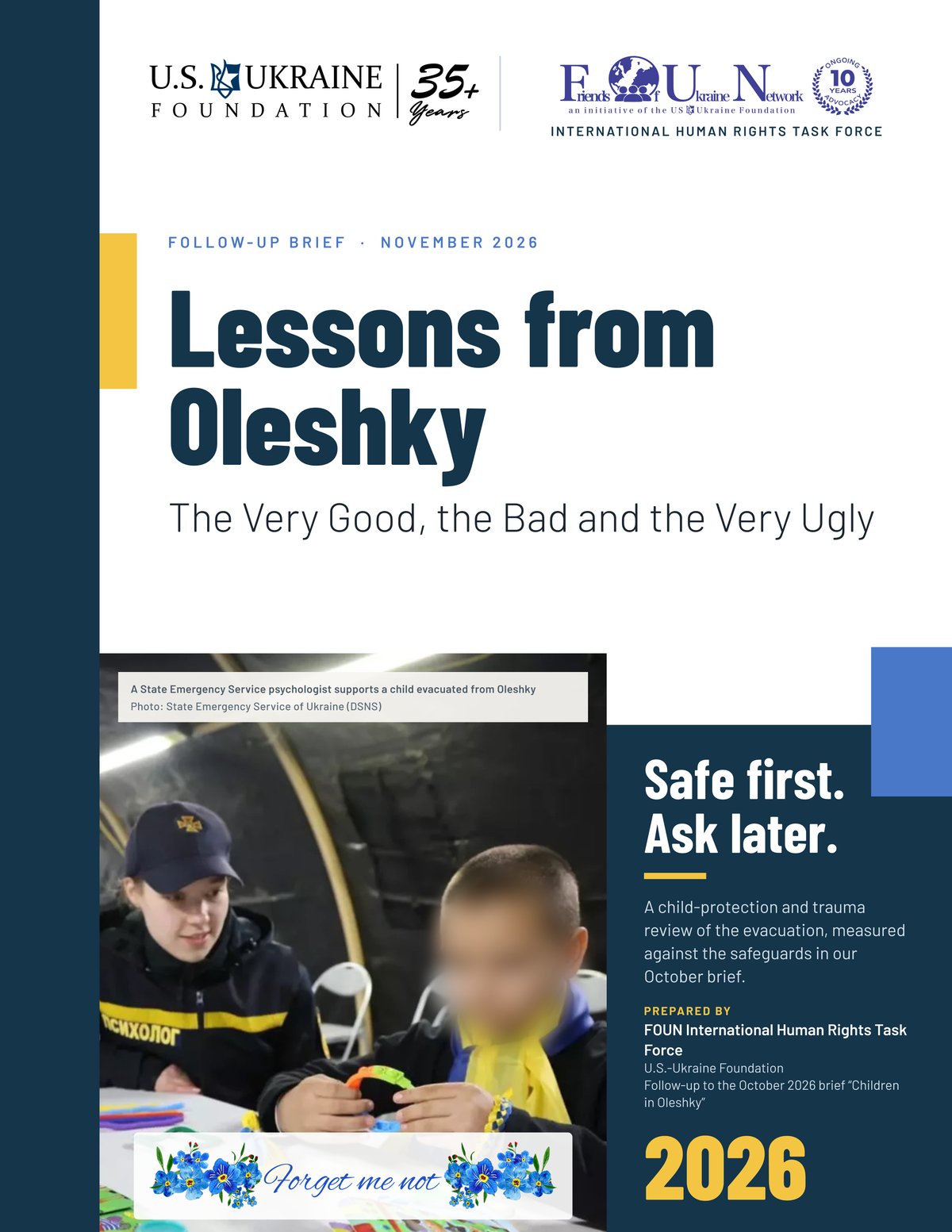
Read the brief (PDF, 6 MB)
Download for print (high-resolution PDF, 21 MB)
The brief finds
- The very good: the evacuation brought hundreds of people out of a besieged, occupied town, including children and elderly residents, which is a genuine humanitarian achievement, and should be recognized as such.
- The bad: the choice of destination country was made at Armiansk, in occupied Crimea, under Russian control. No independent monitor such as the ICRC or UN was directly involved, and evacuees travelled about 19 hours through occupied Crimea, Russia and Belarus.
- The very ugly: Russia used the ceasefire to rotate troops and reinforce positions; strikes on civilians elsewhere continued. At the White House a child’s reported choice was presented as a diplomatic gift.
“A child’s reported choice, made under occupation, was presented as a diplomatic gift.” This is the scenario our October brief warned against.
If this model is repeated
The choice of destination must be made outside occupied territory, independent monitors must have unaccompanied access, and the ceasefire must not become cover for military gains. Evacuees need assessment by qualified trauma specialists and follow-up care, and the people who went to Russia must not be forgotten.
We ask that you share this brief as widely as possible through your networks, including:
- Traditional media and social media commentators
- Your organization’s membership
- Institutional and government contacts
Task Force experts are available for interviews and briefings. Please contact: Olena Oliynyk <olena@usukraine.org>
Thank you for helping protect these children.
With best regards,
Nadia K. McConnell
President, U.S.-Ukraine Foundation