
On June 29, at the House of Sweden, the 30th anniversary of the Constitution of Ukraine was celebrated.
The guests were greeted by Jonas Wendel, Chargé d’Affaires of Sweden, followed by Keynote Remarks by Olha Stefanishyna, Ambassador of Ukraine to the United States.
Historical Reflections were offered by Ambassador Paula Dobrinsky, former Under Secretary of State for Democracy and Global Affairs, the U.S.-Ukraine Foundation’s Robert McConnell, and Michael Sawkiw, President, Ukraine Congress Committee of America.
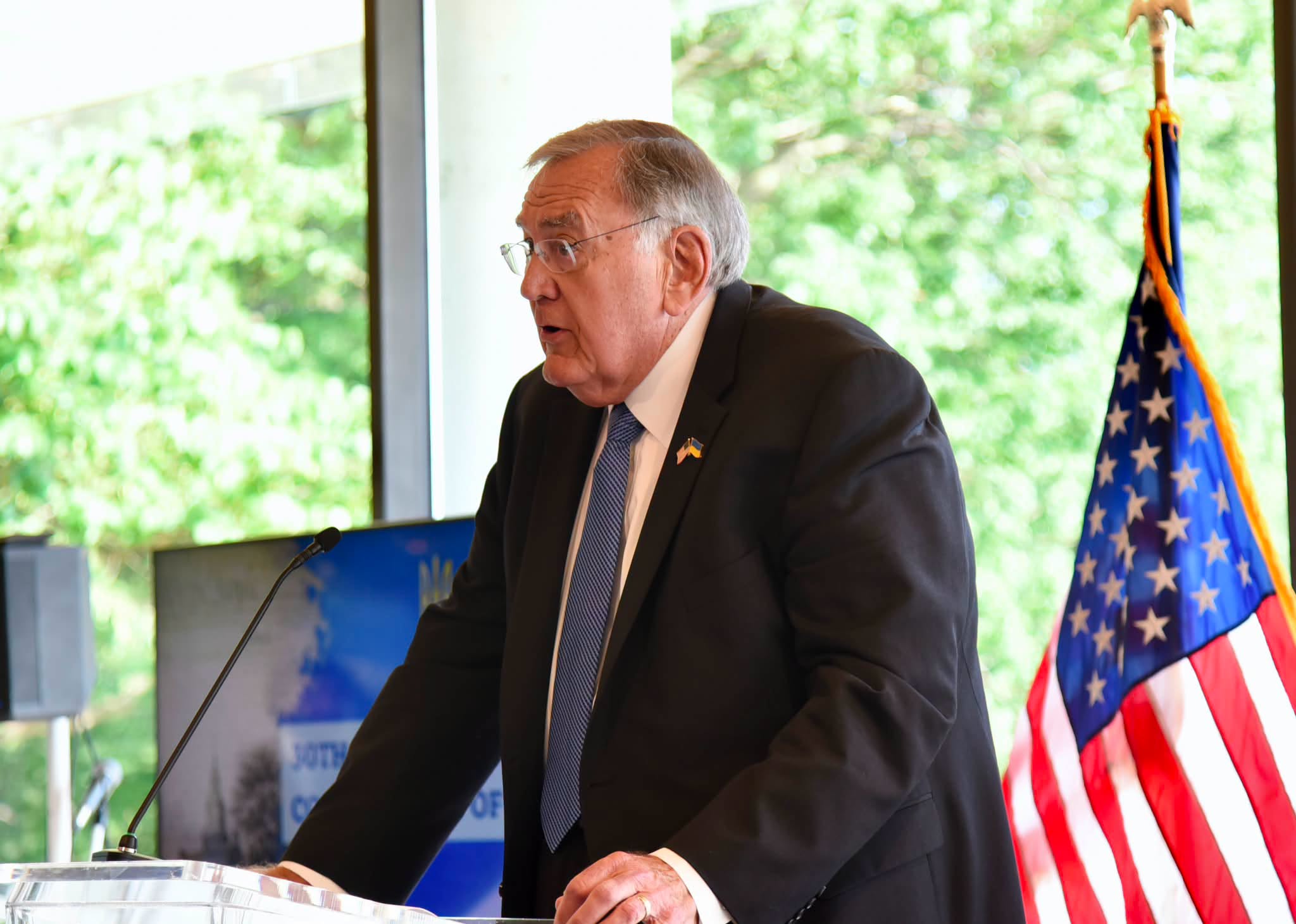
We include Mr. McConnell’s remarks here:
Madam Ambassador, all ambassadors present, guests - It is wonderful once again to be at the House of Sweden.
The hospitality and support Sweden has shown Ukraine historically, and the support being provided today, has been and is important and greatly appreciated. Indeed, you have shown that same great hospitality in hosting the U.S.-Ukraine Foundation, and it has meant so much.
Much has been said most appropriately about the influence and work of the Ukrainian diaspora – it is a critical force in this country, but I do note that when we established the U.S.-Ukraine Foundation, we specifically did not make it a community organization. As Nadia said, we wanted to involve non-hyphenated Americans. The diaspora presents a major constituent voice in Washington, and we wanted to bring those influential non-Ukrainian experts – former U.S. ambassadors, former Supreme Allied Commanders and other experts – to the voices speaking out for Ukraine.
As for the Foundation - in 1990, well over a year before Ukrainian independence, we opened the U.S.-Ukraine Foundation office in Kyiv inspired by the leadership of Rukh and their desire to separate Ukraine from “the center” and achieve independence.
Among other things, we thought it would be important to establish a local, domestic entity announcing clearly Ukraine’s historic democratic roots, making it clear that the people of Ukraine did not need to seek democratic guidance solely from outside of Ukraine.
That, of course, led to the legacy of Pylyp Orlyk, which, of course, includes his being given protection by Charles XII, king of Sweden, and his relentless travels country-to-country seeking support for Ukraine – much like President Zelenskyy is doing today.
But today we focus on Orlyk’s 1710 constitution for Ukraine – establishing a three-branch government with checks and balances, protection of private property, limitations on the privileges and prerogatives of the Hetman, and eliminating the exploitation of the people – long before – over 70 years before the United States Constitution.
Ukraine never saw freedom from Russia during Orlyk’s lifetime, but Orlyk hoped his constitution would eventually be used in a new independent Ukrainian government. So, to sustain his democratic ideals and those of his kindred spirit, James Madison, in 1991 the U.S.-Ukraine Foundation founded the Pylyp Orlyk Institute for Democracy in Kyiv with support from the National Endowment for Democracy. The work of the Institute was and is to make information, research, and advice available to Ukrainian policymakers.
In April 1991, supported by a grant from the United States Information Agency, the U.S.-Ukraine Foundation hosted a two-week program, The American System of Governance, for a delegation of 13 members of the Ukrainian Rada. Rukh’s leadership had requested the program, not because they desired to copy American governance, but because they knew they had never been told the truth and they wanted to understand United States governance.
Throughout that program, our federal system was presented – state, county, and local governance in Indiana and all aspects of our federal government here in Washington.
Indeed, Justice Sandra Day O’Connor hosted the delegation for lunch and a presentation at the Supreme Court, after which then Solicitor General Ken Starr explained the interface between our Executive, Legislative, and Judicial Branches of government. The question-and-answer period that afternoon in the Supreme Court is one I will always remember.
Then, of course, with the national referendum on December 1st, 1991, Ukraine achieved its independence, and the desire to prepare a constitution became a priority for Ukraine.
The Foundation sent The Honorable Ted Olson, former Assistant Attorney General for the Office of Legal Counsel, and future Solicitor General of the United States, to meet with members of the Rada and others who were researching foreign constitutions as well as Ukraine’s own constitutional history.
Then on the July 4th weekend of 1992 - while the people of the United States celebrated our independence - in Kyiv there was held the Symposium on the Ukrainian Constitutionsponsored by the Association of Ukrainian Lawyers and the U.S.-Ukraine Foundation and supported again by the National Endowment for Democracy.
Seven countries were represented at that symposium, including Great Britain, France, Germany, Hungary, Canada, and the United States.
The American delegation included Michael Davidson, former Chief Staff Council of the U.S. Court of Appeals for the District of Columbia, who was, at the time, Legal Counsel to the United States Senate; Judge Bodhan Futey of the U.S. Court of Claims; and Greg Stanton, Professor of Law at American University.
Then in August 2021, the original copy of Orlyk’s Constitution was returned to Ukraine from Sweden for the first time in 311 years. Three official replicas are now proudly displayed in Ukraine’s Parliament, the Presidential Office, and the Constitutional Court. The original manuscript is exhibited at Kyiv’s sacred Saint Sophia Cathedral.
My remarks here may have been U.S.-Ukraine Foundation-centric, but we are proud to have helped when asked by Ukraine’s leaders and to have witnessed up close the birth of Ukraine’s independence and its Constitution.