
Yahoo News reportedly has over 180 million monthly visitors. This week, visitors have seen the article below by Mitzi Perdue, who, among many other things, is one of the U.S.-Ukraine Foundation’s Forget-Me-Notambassadors and a member of the Foundation’s working group on Best Practices for Treating Trauma.
Putin and his team are proud of their formal policy for abducting children, but under the Genocide Convention, the behavior is defined as genocide.
One more bit of evidence that Russia is not a civilized nation and continues its barbarian traditions
Hold Russia Accountable for War Crime of Missing Children
Mitzi Perdue | Wed, July 22, 2026 at 6:54 AM EDT
- The U.S.-Ukraine Foundation is working to reunite abducted Ukrainian children with their families and hold those responsible for the abductions accountable.

The U.S.-Ukraine Foundation is taking on one of the most urgent and morally charged crimes of Russia's war: the abduction and forced Russification of Ukrainian children.
As an example of what happens when children are abducted, take the case of Ksenia Koldin, a child rescued from forced Russification.
She and her brother were kidnapped from Ukraine and sent deep into Russia.
Among the most distressing parts of the experience was, she found herself separated from her brother by nearly 900 miles. The distance was not accidental.
"Separation makes children easier to reshape," Ksenia told me during a recent visit to New York. She was there on behalf of other Ukrainian children rescued from captivity in Russia through Save Ukraine, a charity whose work at times calls to mind our own Underground Railroad.
In Russia, Ksenia was sent to school.
But the purpose was not education.
It was indoctrination.
Day after day, she was told that Russia had invaded Ukraine to protect itself, that Ukraine was overrun with Nazis, and that her homeland was the enemy.
Ksenia resisted. Quietly, stubbornly, she held on to who she was.
Sitting in class, she repeated to herself: Ukraine is going to win. And in her own language: "Slava Ukraini," ("Glory to Ukraine.")
Her younger brother Vadym faced a different reality.
By the time rescuers found him, the propaganda had taken hold. He was afraid to return home. He had been told Ukrainians would kill him.
"I need to stay here," he insisted when Save Ukraine operators tried to rescue him.
They spent hours persuading him to join his sister and return to Ukraine.
Eventually they succeeded. Using methods that cannot be publicly disclosed, Save Ukraine located both children, convinced Vadym to leave, and reunited the siblings in Ukraine.
So far, Save Ukraine has brought back 1,261 abducted children.
It is an extraordinary achievement. And yet it is heartbreakingly small.
The scale of what Ukraine is facing is hard to comprehend, and in addition the actual numbers are hard to pin down.
Ukraine has formally identified more than 20,000 abducted children, and that's a figure you can frequently hear.
But General Andrii Nebytov of the Ukrainian National Police told me that even in the first year of the full-scale invasion, police had records of 100,000 abducted children.
Other officials now believe the number may be in the hundreds of thousands. Russian authorities themselves have claimed that more than 700,000 Ukrainian children have been transferred to Russia.
This is not simply a humanitarian tragedy. It is a deliberate strategy to erase Ukrainian identity.
Children are removed from their homes, stripped of their language and loyalties, and placed in environments designed to make them Russian — in culture, allegiance, and future identity.
Some are adopted into Russian families.
Others are placed in institutions or militarized youth programs.
So far, there is no accountability, and this war crime continues to operate.
That is why the U.S.-Ukraine Foundation's work matters.
For more than three decades, the Foundation has supported Ukraine's democratic development. Today, under the leadership of Nadia K. McConnell, it has launched the Center for Reuniting Families of Ukraine, an initiative grounded in a stark reality: reunification without justice leaves the crime intact.
Their mission is to bring accountability to scale.
They are identifying the individuals and institutions responsible for these abductions.
They are pressing governments to impose targeted sanctions. And they are advocating for the creation of a Special Tribunal to prosecute these crimes under international law.
What would those sanctions actually do?
In practical terms, sanctions can include asset freezes, travel bans, and restrictions on access to international banking systems.
Officials involved in deportation programs can find their foreign accounts blocked, their property seized, and their ability to travel outside Russia curtailed. Institutions — adoption agencies, transport networks, state-run programs — can be cut off from global financing and cooperation.
For individuals inside the system, these measures are more than symbolic.
A regional official, a bureaucrat managing child transfers, or a judge approving adoptions may not control national policy.
But many have personal assets, family ties, or ambitions that extend beyond Russia's borders. Sanctions put those at risk.
Sanctions introduce friction into the chain.
They force individuals to weigh personal cost against compliance.
They create hesitation, slow processes, and in some cases, refusal.
Over time, that erosion can matter. It can make the system less efficient, less scalable, and harder to sustain.
Just as importantly, sanctions establish a legal and moral record. They document responsibility. They signal that these acts are not forgotten, not normalized, and not beyond consequence.
Accountability is not immediate justice. But it is the beginning of it.
The Foundation's work also addresses what happens after children return.
For children like Ksenia and Vadym, coming home is only the beginning. Many return with deep psychological scars shaped by isolation, fear, and indoctrination.
Recognizing this, the Center for Reuniting Families is working to identify best practices in trauma care.
Restoring these children requires more than physical return.
It requires rebuilding identity, trust, and belonging.
This dual focus — justice and healing — is essential.
Because without healing, the damage endures.
And without justice, it repeats.
Mitzi Perdue is a journalist and war correspondent. She has reported extensively from Ukraine and is the co-founder of Mental Help Global, an initiative using AI to expand access to mental health support in conflict-affected regions.
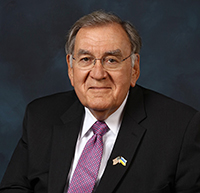
ROBERT MCCONNELL
Co-Founder, U.S.-Ukraine Foundation
Director of External Affairs, Friends of Ukraine Network
The introduction is Mr. McConnell’s and does not necessarily reflect the views of the U.S.-Ukraine Foundation or the Friends of Ukraine Network (FOUN).