
It is hard to keep up with the news and views relating to Vladimir Putin’s war against the United States, Ukraine, and the world order.
I intentionally say Putin’s war against the United States for two reasons. First, having recently participated in the annual Forum 2000 in Prague, I heard over and over from representatives from the “Global South” (Think Africa, South America, and Southeast Asia) that the Russian narrative permeating their news is that Russia is fighting the United States in Ukraine. And second, I believe one would have to have their head buried in the sand not to realize that a country – Russia – that says the United States is its primary enemy is not fighting the United States and its interests around the world.
Having said that, recent news is beyond troubling as, contrary to the views of a significant majority of Americans who support Ukraine and NATO, our government is at best antagonistic toward both.
In this email, I present two articles published today setting out the important views of two members of the U.S.-Ukraine Foundation’s Friends of Ukraine Network FOUN).
The first is from the Kyiv Post reporting on General Philip Breedlove, USAF (ret), former Supreme Allied Commander – Europe, and a member of FOUN’s National Security Task Force.
The second is an op-ed from The Wall Street Journal by Robert B. Zoellick, former U.S. Trade Representative and former president of the World Bank, who is a member of FOUN’s Reimagining, Reconstruction, and Recovery of Ukraine Task Force.
I believe both demand our attention.
KYIV POST
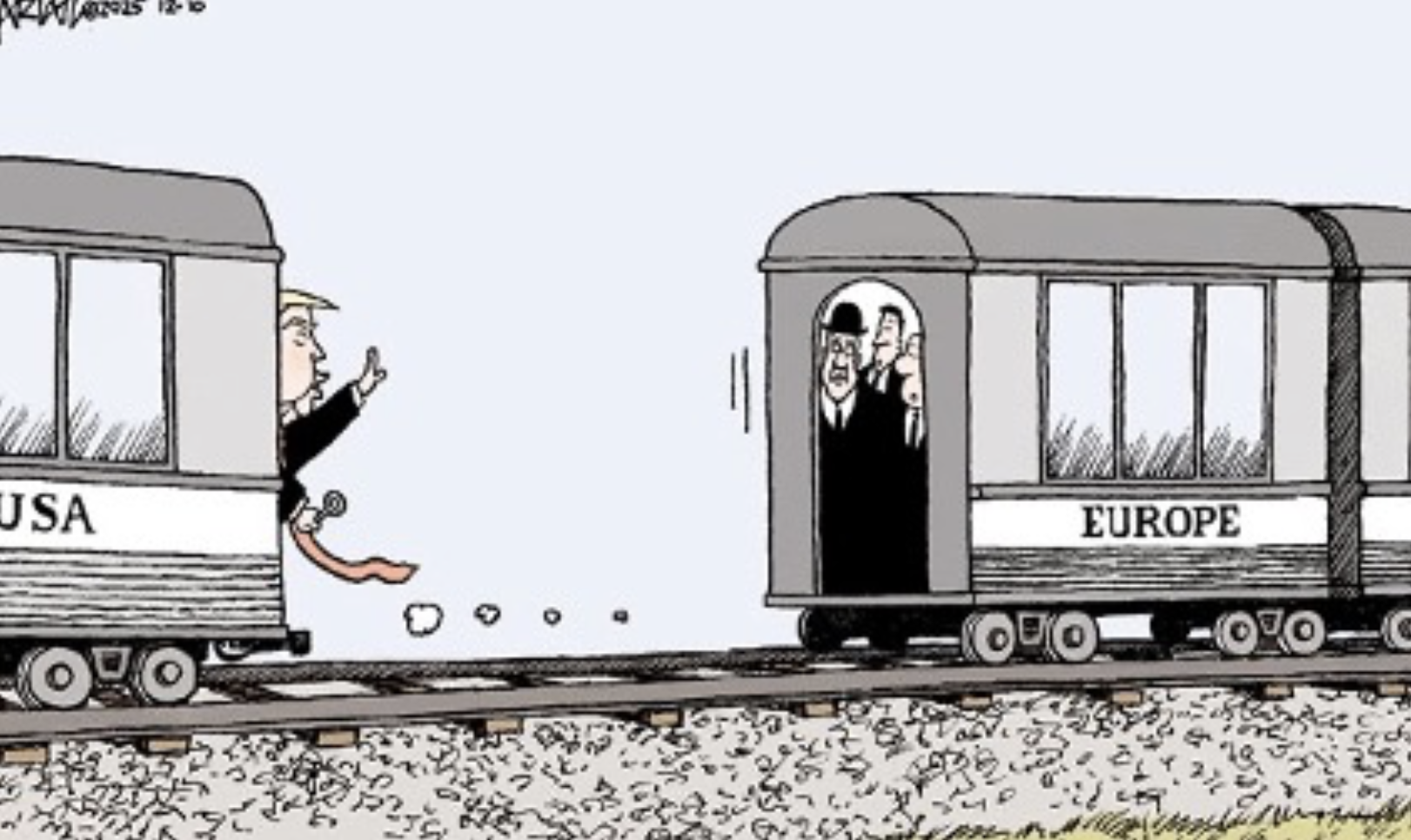
America ‘Cannot Defend Itself Alone’ – Ex-NATO Commander Urges US to Stay Committed to Europe
Retired Gen. Philip Breedlove tells Kyiv Post that abandoning allies would leave both Europe and the US vulnerable to emerging threats.
By Alex Raufoglu | Dec. 11, 2025, 6:02 am
WASHINGTON DC – Retired US Air Force Gen. Philip Breedlove, the former NATO Supreme Allied Commander, warned Wednesday that amid political turbulence in Washington, the United States is neither prepared nor positioned to abandon its allies and confront emerging threats alone, telling Kyiv Post in a wide-ranging interview that Europe’s security depends on sustained American commitment.
While he declined to wade into partisan critiques, he drew a sharp distinction between the posture of the current US administration and the enduring instincts of the American public – a contrast he suggested Europe should take seriously as it evaluates the implications of the new US National Security Strategy.
Strategy that echoes Moscow
Breedlove underscored that the latest NSS reflects the Trump administration’s current policy preferences, not a permanent shift in American grand strategy.
Still, he said the document contains elements that raise concern, including what he described as a de-prioritization of Europe and a framework that tracks uncomfortably closely with the “spheres of influence” worldview long espoused by Vladimir Putin.
According to Breedlove, the NSS resembles the multipolar arrangement Russia has been arguing for over the past decade-plus – one that divides the world into regional zones of dominance.
In his view, this alignment with Moscow’s preferred architecture is “deeply concerning,” not because it makes US policy permanently fixed, but because it signals acceptance of an adversary’s strategic framing at a sensitive moment.
The US voted against Ukraine’s Chornobyl resolution at the UN, aligning with Russia and saying its objection was to references to the 2030 Agenda, not Ukraine or nuclear safety.
At the same time, Breedlove stressed that polling consistently shows strong American public support for NATO and for assisting Ukraine.
That enduring sentiment – not the transient priorities of any one administration – should reassure European partners, he suggested.
Putin ‘will come back’ – and Europe must prepare
When asked whether Europe must accelerate readiness targets across critical capabilities, from air defense to ISR to logistics and cyber, Breedlove did not hesitate. Europe, he said, needs all of it – urgently.
He noted that while he does not engage in politics, it was President Trump who succeeded, however controversially, in pushing NATO members to significantly increase defense spending.
After what Breedlove described as a “25 to 30-year procurement holiday” following the Cold War, Europe is now racing to catch up – and needs to continue doing so.
He argued that Putin’s own documents and public statements leave no ambiguity about Moscow’s aims: a restructuring of Europe’s security order reminiscent of the USSR and Warsaw Pact era.
Russian officials’ recent remarks that “we’re not done in Europe,” he said, are not rhetorical flourishes but strategic intent.
Ukraine’s defense of its territory has significantly degraded Russia’s ground forces, Breedlove noted, buying Europe a window of time.
But that window will close. Putin, he said, “will come back,” and Europe must use the present years to prepare for his next move.
Real weapons, real authority, real timelines
Breedlove said the most important immediate step for Europe is not another round of declarations but adopting policies that result in rapid, tangible movement of capabilities to Ukraine – paired with the authority for Kyiv to use them effectively.
He warned that Europe and the US alike are unprepared for the scale of aerial attacks Russia conducts nightly against Ukraine.
Hundreds of drones, he said, represent a threat for which neither NATO nor the EU – nor the US homeland – currently has sufficient defenses.
Asked about some Republican calls to withdraw from NATO, Breedlove described a scenario that illustrates America’s own vulnerabilities: a container ship entering a major port, releasing swarms of hostile drones.
The US, he said, would be “completely defenseless” against an attack modeled on the kind of long-range, deep-strike drone operations already demonstrated in Ukraine and the Middle East.
Adversaries know how to do this. The US, he emphasized, is not prepared – another reason why abandoning allies would not enhance American security but undermine it.
Europe’s best signal to Washington: Show you’re serious
As to European defense leaders hoping to maintain deep military cooperation with the US during political friction, Breedlove’s message was blunt: demonstrate seriousness.
He argued that if Europe shows clear intent to arm itself and take primary responsibility for its defense, it will undercut domestic US arguments for disengagement.
Signaling – and acting on – that commitment, he said, is the surest way to maintain strong military-to-military ties.
In a moment when slogans compete with strategy, Breedlove’s assessment lands with characteristic force: America’s alliances endure because its people understand what its adversaries intend – and because facing that danger alone would be a perilous illusion.
If Washington wavers, he suggests, the ensuing global power vacuum would be a catastrophic victory for America’s enemies, leaving the continent’s security to hang in the balance.
THE WALL STREET JOURNAL
White House National-Security Strategy Reflects Vance’s Thinking
It’s an odd amalgam of regional balances of power and calls for the renewal of civilization.
By Robert B. Zoellick | Dec. 10, 2025 3:39 pm ET
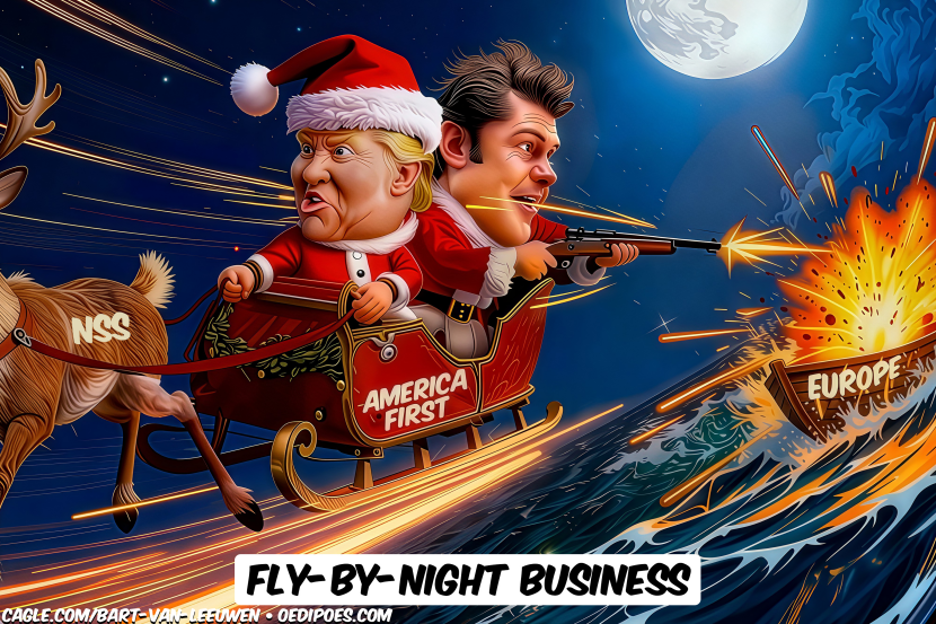
The 2025 White House National Security Strategy is revealing—especially about Vice President JD Vance’s worldview. As a practical matter, the document won’t constrain Donald Trump’s ambition to become the “president of peace” through deals. But the authors of this document—likely led by Andy Baker, deputy national security adviser and a former aide to Mr. Vance—have explained how they would create a new framework after Mr. Trump’s destruction of the old order.
The strategy forges an odd geopolitical-cultural amalgam of regional balances of power and calls for spiritual, familial and civilizational renewal. It foresees a competition among nation-states with spheres of influence, cultures of greatness, and nationalized economies—which make the strategy document reminiscent of rhetoric before World War I.
The regional strategy opens with the Western Hemisphere, calling for a “Trump Corollary” to the Monroe Doctrine, imitating Theodore Roosevelt’s revision. Foreign policy is connected directly to domestic interests, calling for a halt of “destabilizing” migration and the use of the military against narco-traffickers. Instead of relying on the attractive power of the U.S. economy and democracy, the administration will impose economic costs to compel Latin American nations to play along. There is no hint about the administration’s plans for Venezuela, except that the strategy places a “high bar” for intervention and expresses a general desire to avoid wars.
European policy represents the biggest change. The administration contends that Europe faces economic stagnation and “civilizational erasure.” It abhors the European Union’s shared sovereignty. Mr. Vance’s faith in national populism leads him to object to European democracies’ responses to historical fears about political extremism and Russian influence. The language disturbingly echoes Vladimir Putin’s criticism of Europe. For a document that praises America’s “past glories,” the plan dismisses beneficial ties with Britain, lumping it with Ireland as a place to which the U.S. is “sentimentally attached.”
The strategy treats Europe and Russia as politically equivalent. The U.S. role will be to mediate a restoration of stable security in Europe. Ukraine is an irritant that gets in the way of a deal, with no recognition that Mr. Putin’s subjugation of Ukraine will increase dangers, not ensure security.
Although some in the White House have trumpeted Indo-Pacific security as the priority, the strategy for the region seems uninspired except for economic protectionism. The document stresses free navigation, especially for supply chains. The plan is to deter China while recognizing long-term “economic battlegrounds.” Taiwan remains in a holding pattern. American allies will need to expand their military roles while following Washington’s lead on industrial policy and economic security. The strategy leaves room for economic coexistence with China—trade in nonsensitive sectors—if economic relations can be rebalanced.
In the Mideast, the authors are eager for Washington to get on with its long-delayed pullback, even though the president is engaged with the region as he busily searches for peace deals. The strategy relies on the Gulf monarchies to maintain security in some association with Israel. Africa is an afterthought—a source of natural resources.
The vice president’s psychology of populist grievance underpins these regional strategies. He appeals to resentments about past overreach, unfair burdens, unreliable foreigners, the woke agenda, the elites—and especially migration. Yet the document adds its own globalist ideology of protecting national cultures against foreign influences and migration. In some bizarre way, Mr. Trump’s American greatness is supposed to be a soft power that will lead to cultural rebirth of diverse peoples around the globe.
The strategy relies heavily on industrial policy, tariffs and White House direction to achieve economic security. It perceives economic growth as in tension with American workers—and growth must yield. Trade deficits are “unsustainable,” but budget deficits are unmentioned. The plan assumes a powerful, technologically sophisticated military and industrial base but doesn’t commit to paying the bills for those things.
In the best light, the new strategy imitates Theodore Roosevelt’s effort to take advantage of America’s rising influence and mediate balances of power in East Asia and Europe while dominating North America and the Caribbean. But the new document ignores the lessons of the century that followed. Wars in Europe and the Pacific threatened America directly. After World War II, America had to build alliances to counter threats, including from the Soviet empire, and preserve security in the western and eastern reaches of Eurasia.
Along the way, the U.S. promoted win-win economic ties for trade, investment, development and innovation. North American economic integration created a stronger continental base and a better basis for dealing with shared interests. With effective assimilation, legal immigration enhanced America’s size and strength. America’s freedom inspired others.
Mr. Vance and his disciples have explained their strategy clearly—if not always coherently. Those who recognize the dangers of this sharp historical turn need to speak out.
Mr. Zoellick served as U.S. trade representative (2001-05), deputy secretary of state (2005-06) and World Bank president (2007-12). He is author of “America in the World.”
ROBERT MCCONNELL
Co-Founder, U.S.-Ukraine Foundation
Director of External Affairs, Friends of Ukraine Network
This introduction is Mr. McConnell’s and does not necessarily reflect the views of the U.S.-Ukraine Foundation or the Friends of Ukraine Network (FOUN).