
THE NATIONAL INTEREST
The Perils of Russian Diplomacy
As momentum toward a Ukraine deal builds, the US should be focused on gauging Russian sincerity.
October 28, 2026
By Donald Jensen and Shelby Magid
Russia’s recent diplomatic activity has raised hopes of progress toward ending the war in Ukraine and improving US-Russia relations. The diesel arrangement, renewed peace talks, offers of commercial cooperation, and the temporary humanitarian ceasefire in Russian-occupied Oleshky all suggest movement toward a deal. But Moscow’s willingness to negotiate now should not be mistaken for a willingness to compromise. [And please read Mitzi Perdue’s piece, “When a Child’s ‘Yes’ Is About Survival – Liberated children from Oleshky may not be able to choose freely” in Psychology Today. The Oleshky “ceasefire” has demonic aspects to it. RAM]

For the Kremlin, diplomacy is not an alternative to confrontation. It is one instrument Moscow uses to pursue its objectives. Russian negotiators combine inducements, coercion, and limited concessions to influence their counterparts, alter the terms of discussion, and secure advantages without abandoning their principal demands.
Following an October 9 understanding between presidents Donald Trump and Vladimir Putin, Washington authorized transactions involving Russian diesel that US sanctions had previously restricted. The arrangement offered Moscow potential economic benefits as it continued its war against Ukraine. Russian officials later promoted broader energy and commercial cooperation, touting improved bilateral relations.
Moscow’s commercial overtures began before October. Since early 2025, Kirill Dmitriev, Putin’s special envoy for international economic cooperation, has promoted prospective deals involving energy, critical minerals, investment, and technology. Discussions with American officials have included the possible return of ExxonMobil to Russia’s Sakhalin-1 project and cooperation in liquefied natural gas. These proposals offer Washington a vision of improved bilateral relations even as Moscow remains unwilling to compromise on its principal demands concerning Ukraine.
The Trump administration has reasons to test whether economic incentives can encourage Russian flexibility. Moscow, however, has its own calculations. By offering the prospect of commercial cooperation, the Kremlin seeks to weaken sanctions pressure and broaden the bilateral agenda beyond Ukraine. Washington must ensure prospective economic benefits remain bargaining chips, not rewards granted before Moscow changes its position.
In a February 2026 Atlantic Council report, Adversary at the Table: Negotiating with Putin’s Russia, Jensen and Iuliia Osmolovska examined how the Kremlin uses negotiations as an arena for strategic competition. Russian tactics include maximalist opening positions, flattery, tactical concessions, and promises of future rewards. Negotiations can shift the agenda and extract concessions rather than resolve the underlying dispute.
At the August 2025 Alaska summit, Putin appealed to Trump’s interest in economic and strategic cooperation while making no substantive concessions on Ukraine. October’s initiatives follow a recognizable pattern. The Kremlin seeks to influence not only the terms of a prospective settlement but also the other side’s political and economic calculations. Diplomatic activity itself can create expectations of progress even when Moscow’s underlying position remains unchanged.
On October 16, Pope Leo XIV appealed directly to Putin for a ceasefire permitting humanitarian deliveries and the voluntary evacuation of civilians trapped in Russian-occupied Oleshky. Further discussions followed the Vatican initiative. On October 23, the White House announced an agreement that First Lady Melania Trump helped negotiate.
The first lady’s efforts to secure humanitarian relief deserve recognition. Whatever the wider diplomatic implications, assistance to trapped civilians and genuinely voluntary evacuations would be valuable achievements. Yet Oleshky’s circumstances show why a humanitarian agreement must also be assessed in its political and military context.
Oleshky lies across the Dnipro River from Kherson, the strategically important regional capital Ukraine recaptured in November 2022. Russian forces have used positions along the occupied bank to attack the city, including systematic drone strikes against civilians. Oleshky has suffered flooding, destruction, shortages, and movement restrictions. Residents have struggled to obtain drinking water, food, and medicine or to leave safely. International monitors have received accounts of Russian forces preventing evacuations and using civilians to shield military positions.
Under the Fourth Geneva Convention, Russia, as the occupying power, must ensure essential food and medical supplies for civilians to the best of its available means. Facilitating humanitarian relief and allowing safe evacuation are not extraordinary concessions. Moscow was already obliged to meet these responsibilities.
Conditions in Oleshky deteriorated sharply after the destruction of the Kakhovka dam in June 2023. The OSCE has documented severe humanitarian conditions in the occupied area, including shortages and obstacles to evacuation. Moscow could now receive diplomatic credit for helping alleviate a crisis that has developed under its occupation.
The proposed evacuation raises additional questions. Will civilians be able to reach Ukrainian-controlled territory freely, or will some face pressure to move to Russia? For children and other vulnerable residents, prolonged occupation, restricted access to information, and possible intimidation make genuinely voluntary choices especially difficult to assess. International humanitarian law prohibits forcible transfers from occupied territory, subject to narrowly defined exceptions. Presenting the crisis as one for which Ukraine and Russia bear equivalent responsibility would obscure Russia’s particular obligations as the occupying power. [Again, Mitzi Perdue’s article in Psychology Today. RAM]
Concerns also remain about the information campaign surrounding the operation. On October 7, Ukraine’s Security Service warned that Russian forces were preparing staged interviews with residents blaming Ukraine for the humanitarian catastrophe. Journalist Zarina Zabrisky, reporting from Kherson, has documented previous Russian efforts to manipulate foreign reporting through controlled visits to occupied territory. Her findings raise questions about who will control access to Oleshky and what international audiences will be permitted to see.
The agreement may deliver genuine humanitarian benefits. It could also enable Moscow to shift responsibility for conditions in Oleshky while claiming diplomatic credit.
The diesel arrangement and Oleshky initiative differ in origin and purpose. The first involves commercial interests and sanctions. The second concerns urgently needed humanitarian assistance. No evidence suggests both are part of a single coordinated operation. Nevertheless, each could improve Moscow’s diplomatic position without requiring concessions on the issues central to the war. In Oleshky, Russia may even gain credit for partially fulfilling obligations it should have met all along.
Meanwhile, Russian military operations have continued despite renewed diplomatic activity. October’s reported attacks on commercial shipping near Romania and Bulgaria have heightened tensions in the Black Sea, while strikes against Ukrainian cities and energy infrastructure continue. For the Kremlin, negotiations and military pressure can run in parallel. The prospect of improved relations does not necessarily restrain Russian operations.
The United States has good reasons to pursue negotiations, particularly when agreements can save lives or reduce immediate risks. But diplomatic activity is not itself a measure of progress. Washington must distinguish limited transactions from substantive changes in Russian policy. Assess a humanitarian agreement by whether civilians receive protection and assistance. Judge an economic arrangement by the concessions it secures and the leverage it preserves. Neither should be mistaken for movement toward peace without corresponding changes in Moscow’s demands and conduct.
Washington also has leverage that it should not discount. Ukrainian strikes have disrupted Russian refining capacity. Sanctions, mounting military expenditures, and other economic pressures constrain Moscow’s choices. Putin’s interest in economic relief and improved relations with Washington reflects both vulnerability and ambition. American negotiators should understand those pressures and use them to their advantage.
Effective negotiations with Russia require understanding the Kremlin’s methods, objectives, and constraints. Washington should insist on reciprocal, verifiable commitments, coordinate closely with Ukraine and European allies, and avoid trading leverage for promises of future cooperation.
Putin is prepared to negotiate. Whether he is prepared to compromise remains the unanswered question. Washington should judge the Kremlin by what it gives up and what it does, not by how many diplomatic initiatives it launches.
About the Authors: Donald Jensen and Shelby Magid
Donald N. Jensen is an adjunct fellow at the Foundation for the Defense of Democracies, where he focuses on Russian intelligence, disinformation, and other Kremlin malign influence activities. He also teaches as an adjunct professor at the Krieger School of Arts and Sciences, Johns Hopkins University. A former US diplomat, Jensen provided staff support for the START, INF, and SDI negotiations. While posted at the US Embassy in Moscow in 1991, he witnessed firsthand the end of the USSR.
Shelby Magid is the deputy director of the Atlantic Council’s Eurasia Center, where she oversees the Center’s strategy, programming, and policy work on Ukraine and the broader Eurasia region. Before joining the Atlantic Council, Shelby worked at the German Marshall Fund of the United States. Shelby serves on the advisory board of Teach for Ukraine.
ROBERT MCCONNELL
Co-Founder, U.S.-Ukraine Foundation
Director of External Affairs, Friends of Ukraine Network
Winter Relief Mission


Phase One: Ukraine Airlift
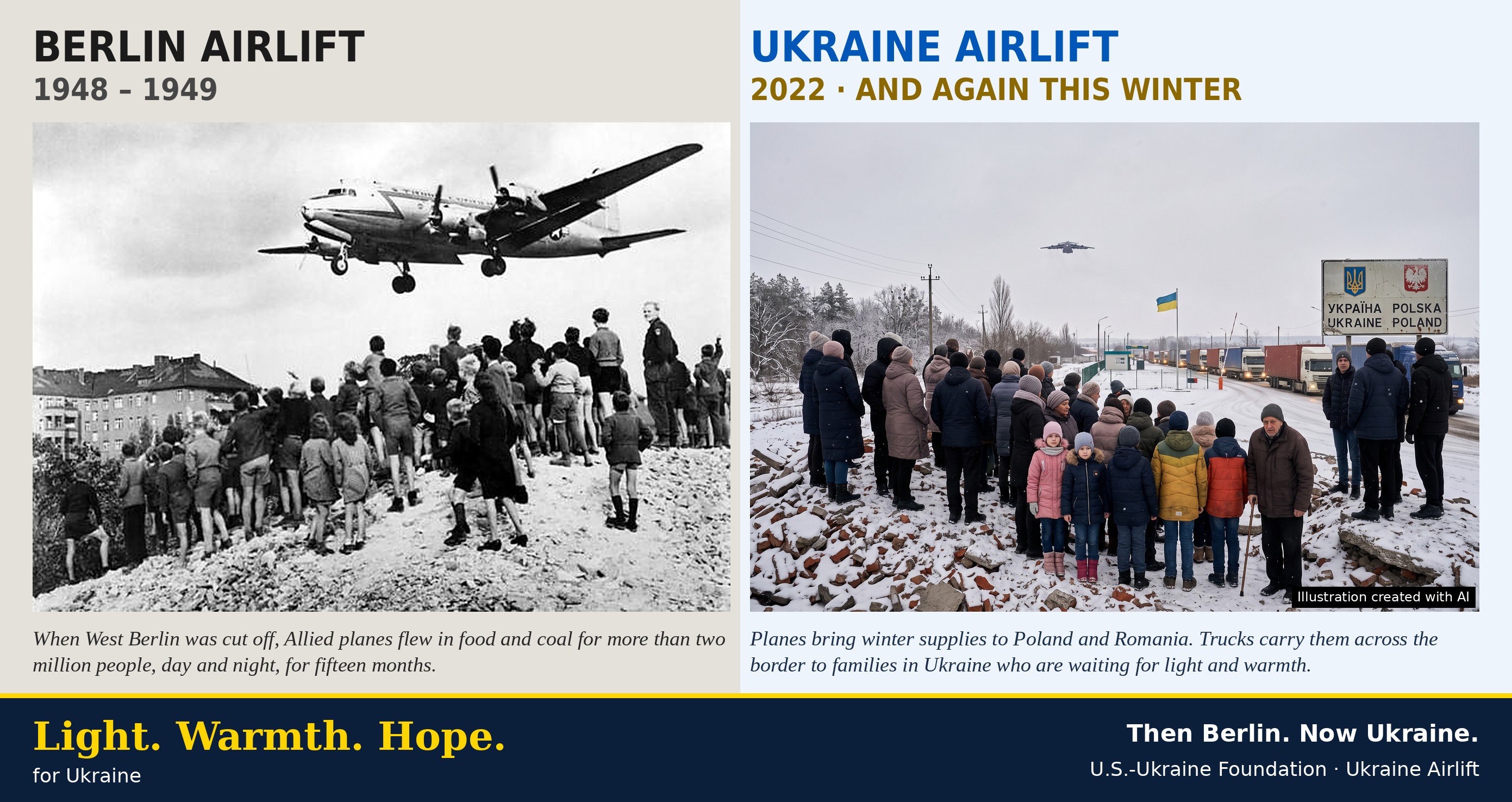
Together with TAPS Ukraine and Mental Help Global, the U.S.-Ukraine Foundation is relaunching the Ukraine Airlift of 2022. Hats with rechargeable lights, warm socks and gloves, rechargeable hand warmers, and food kits will travel by air and by sea container to Poland, then by truck into Ukraine, to reach children and the most vulnerable.